Cpio Review / BLS / Nonfarm Payrolls
Nonfarm Payrolls Jump 162,000 in August; Jobless Rate Holds at 4.1%
August nonfarm payrolls rose by 162,000, five times the recent average, led by restaurants and local schools, while revisions erased July's reported decline.
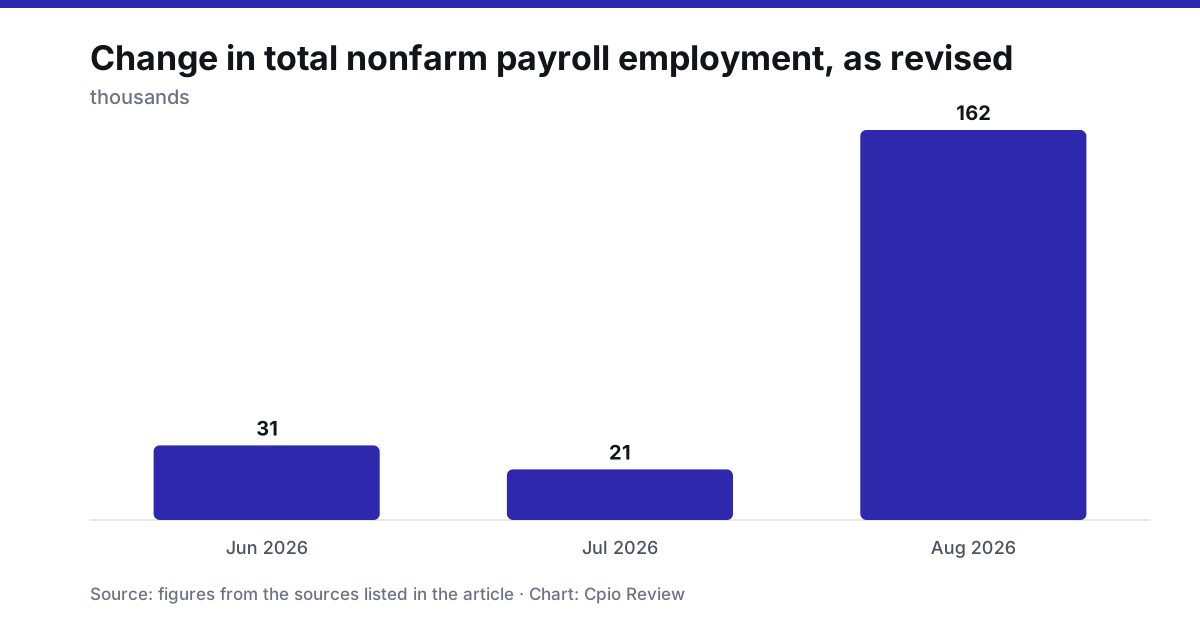
Nonfarm payrolls rose by 162,000 in August, the Bureau of Labor Statistics reported on Friday, a sharp improvement on a labor market that had added an average of only 31,000 jobs a month over the previous year. The unemployment rate was unchanged at 4.1 percent. Just as important, the agency revised July from a loss of 23,000 jobs to a gain of 21,000, which removes the one negative month from the recent record.
The headline number is better than it has been in some time, but its composition limits how much weight it can bear. Two industries, food services and local government education, account for more than 100,000 of the gain, and both are categories where one month’s figure can reverse the next.
Where August’s nonfarm payrolls came from
Employment in food services and drinking places increased by 59,000, well above the average monthly gain of 12,000 over the prior 12 months. Local government education added 42,000 jobs, largely offsetting a decrease in the prior month; the BLS notes that the sector has shown little net change since January 2025. Between them, the two categories supplied 101,000 of the 162,000 total.
Manufacturing continued its upward trend, adding 16,000, and has gained 58,000 since a recent low in December 2025. Machinery manufacturing and fabricated metal product manufacturing each added 6,000. Construction employment changed little at +22,000, with nonresidential specialty trade contractors adding 8,000, similar to their average monthly gain of 6,000.
Health care added 13,000, less than half of its average monthly gain of 32,000 over the prior 12 months. Home health care services contributed 11,000 and hospitals 8,000. That average is close to the 31,000 monthly gain for all nonfarm payrolls over the same period, so health care alone has accounted for essentially the whole of the recent trend.
The information industry was the main loser, with employment down 23,000, compared with an average loss of 8,000 a month over the prior year. Computing infrastructure providers, data processing, web hosting and related services lost 8,000, publishing industries lost 7,000, and broadcasting and content providers lost 5,000. Other major industries, including retail trade, financial activities, professional and business services, and transportation and warehousing, showed little change.
Revisions turn July around
The revisions were large enough to change the story of the summer. The change for June was revised up by 11,000, from +20,000 to +31,000, and the change for July was revised up by 44,000, from -23,000 to +21,000. With these revisions, employment in June and July combined is 55,000 higher than previously reported.
The sequence of monthly gains now reads 31,000 in June, 21,000 in July and 162,000 in August. The revisions came from additional reports received from businesses and government agencies and from recalculation of seasonal factors. The BLS says August’s gain in local government education largely offset a decrease in the prior month, so part of the summer’s weakness in that sector has already reversed.
Averaging the three months gives about 71,000 a month, which is still modest even with August’s strength.
Unemployment rate and the household survey
The unemployment rate stayed at 4.1 percent, and the number of unemployed people changed little at 7.0 million. A year earlier the rate was 4.3 percent. Among worker groups, the rate for Asian workers fell to 3.2 percent, and the rate for teenagers rose to 14.1 percent, mostly offsetting a decline the prior month. Adult men were at 4.0 percent, adult women at 3.5 percent, White workers at 3.7 percent, Black workers at 6.0 percent and Hispanic workers at 4.8 percent.
The labor force participation rate edged up to 61.6 percent from 61.4 percent but remains 0.5 percentage point below its January level. The employment-population ratio was 59.1 percent. The civilian labor force grew by 683,000 and employment by 569,000 in the household survey, which is why the unemployment rate did not fall despite the rise in jobs; more people came into the labor force, and about one in six of the added workers counted as unemployed.
The number of people working part time for economic reasons fell by 414,000 to 4.4 million, a large monthly change. Long-term unemployed workers, jobless for 27 weeks or more, were little changed at 1.9 million, making up 27.0 percent of the unemployed. Job leavers rose by 121,000 to 914,000, and the number of discouraged workers was 441,000.
Wages and hours
Average hourly earnings for all private nonfarm employees rose 10 cents, or 0.3 percent, to $37.75, and are up 3.1 percent over the year. For production and nonsupervisory employees, the average rose 11 cents to $32.53. The average workweek edged up 0.1 hour to 34.4 hours; in manufacturing it rose 0.1 hour to 40.5 hours with overtime unchanged at 3.1 hours.
What to watch
The September Employment Situation is scheduled for October 2. Three issues will decide how this report is read in hindsight. The first is whether restaurant hiring and school employment hold. Both could fall back if August’s strength reflects timing around the start of the school year. The second is health care, where a slower pace of hiring would remove a stabilizer. The third is whether participation keeps rising. The rate has recovered 0.2 point from July but is still below where it started the year, and a stable unemployment rate with a rising participation rate is a better outcome than the same rate reached because people stopped looking.
A single month does not establish a turn in the labor market. A rise of 162,000, following two weak months, is the first piece of evidence that the slowdown of the summer may have been temporary, and the revisions now suggest the slowdown was less deep than first reported.
Prepared with AI assistance from the releases listed under Data sources and reviewed under our editorial policy. Not investment advice.