Cpio Review / BLS / Nonfarm Payrolls
Nonfarm Payrolls Rise 165,000 in October; Jobless Rate 4.1%
Nonfarm payrolls rose 165,000 in October and the unemployment rate held at 4.1%, while August and September were revised up by a combined 84,000 jobs.
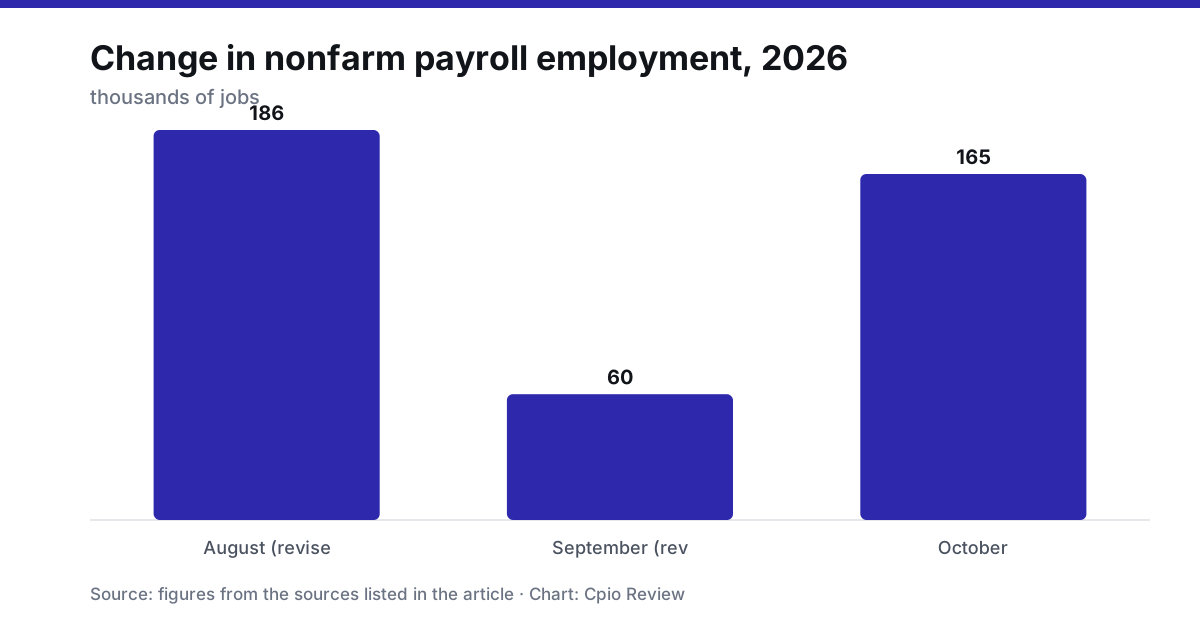
Total nonfarm payroll employment rose by 165,000 in October, and the unemployment rate changed little at 4.1%, the Bureau of Labor Statistics reported on November 6. The gain is well above the 48,000 monthly average of the prior 12 months, and revisions to the two previous months added 84,000 jobs. The labor market that emerges is steadier than the weak September first print suggested, though the household survey includes a sizable rise in involuntary part-time work.
Nonfarm payrolls: a stronger October and upward revisions
The establishment survey showed gains in professional and business services, health care, and transportation and warehousing. The bureau’s summary puts the October increase above the average monthly gain of 48,000 over the prior 12 months.
Revisions matter as much as the headline. August was revised up by 53,000, from +133,000 to +186,000, and September was revised up by 31,000, from +29,000 to +60,000. Combined, employment in the two months is 84,000 higher than previously reported. September’s first estimate of 29,000 had looked like a sharp slowdown; with the revision the three-month sequence reads 186,000, 60,000 and 165,000. The BLS notes that monthly revisions come from additional reports received from businesses and government agencies and from recalculated seasonal factors.
Where the jobs came from
Professional and business services added 70,000 jobs, well above its 12-month average gain of 15,000. Within it, professional, scientific and technical services rose 33,000, administrative and support and waste management and remediation services 28,000, and management of companies and enterprises 9,000. The sector has added 269,000 jobs since a recent low in October 2025.
Health care added 42,000 jobs, above its average monthly gain of 31,000. Hospitals contributed 16,000, home health care services 11,000 and outpatient care centers 5,000.
Transportation and warehousing added 25,000 jobs, with couriers and messengers up 17,000 and air transportation up 4,000. The industry has added 104,000 jobs since a recent low in February, and couriers and messengers account for 71,000 of that.
Manufacturing rose 19,000 in October and has increased by 101,000 since a recent low in December 2025. Computer and electronic product manufacturing added 7,000, machinery 4,000 and primary metals 4,000. Employment showed little change in other major industries, including construction, retail trade, financial activities, leisure and hospitality, and government.
The unemployment rate and the household survey
The unemployment rate was 4.1% and the number of unemployed was 7.1 million, both little changed. The rate has stayed in a narrow range of 4.1% to 4.3% since March. The rate was 4.1% in August, 4.2% in September and 4.1% in October, so it has gone sideways for most of the year while payroll growth has been uneven.
Participation edged up to 61.9% and the employment-population ratio to 59.3%, both little changed, with the bureau noting they have shown little net change since January. The labor force grew by 421,000 and employment by 463,000 in the household survey, while unemployment fell by 41,000.
Rates for most groups moved little: adult men 3.9%, adult women 3.6%, teenagers 13.9%, White workers 3.7%, Black workers 6.6%, Asian workers 2.8% and Hispanic workers 4.7%. By education, the rate for workers 25 and older without a high school diploma rose 1.5 points to 5.8%, while high school graduates with no college fell 0.6 point to 3.8%. Those subgroup series are volatile from month to month.
The long-term unemployed, those jobless for 27 weeks or more, numbered 2.0 million, or 27.6% of all unemployed people. The less-than-5-weeks group stood at 2.17 million, up from 2.10 million in September, while the 5-to-14-week group fell by 219,000 to 1.74 million.
The soft spot: part-time work for economic reasons
The number of people working part time for economic reasons increased by 339,000 to 4.8 million. These workers would have preferred full-time jobs but had hours cut or could not find full-time work. Within that group, those on slack work or business conditions rose by 356,000 to 3.3 million, while those who could only find part-time work were essentially unchanged at about 1.27 million.
That detail is a reminder that the unemployment rate is a narrow measure. A payroll gain of 165,000 and a rate of 4.1% coexist with more workers whose hours were cut. The number of people not in the labor force who want a job was 6.0 million, little changed, and the marginally attached numbered 1.6 million. Discouraged workers were 448,000.
Wages and hours
Average hourly earnings for all employees on private nonfarm payrolls rose 14 cents, or 0.4%, to $38.00 in October and are up 3.1% over 12 months. For production and nonsupervisory employees, hourly earnings rose 12 cents, or 0.4%, to $32.75. The average workweek for all private employees held at 34.4 hours. Manufacturing hours were unchanged at 40.5 and overtime edged up 0.1 hour to 3.1 hours.
Wage growth of 3.1% over 12 months is the figure to set against consumer price inflation. Real earnings depend on that comparison, and the employment report does not make it.
How to read the pieces together
The two surveys can point in different directions in any single month, and October is an example. The establishment survey counts jobs at businesses and government agencies and shows a gain of 165,000. The household survey counts people and shows employment up 463,000, a larger number, alongside a rise in involuntary part-time work. Both agree on direction, and neither alone settles how tight the labor market is.
The more important comparison is the trend. With revisions, the three-month path of 186,000, 60,000 and 165,000 averages 137,000, far above the 48,000 average of the prior 12 months, yet the unemployment rate has barely left its 4.1% to 4.3% band. Faster hiring that does not move the rate can mean more people are entering the labor force, which the 0.1 point rise in participation to 61.9% is consistent with.
What to watch
The November Employment Situation is scheduled for Friday, December 4. Three questions will guide the read: whether professional and business services, which beat its trailing average by a wide margin, holds its gain; whether part-time work for economic reasons retraces the October jump; and whether revisions again move the prior months. Payroll growth has been volatile, and a single strong month sits beside a 12-month average of 48,000.
Prepared with AI assistance from the releases listed under Data sources and reviewed under our editorial policy. Not investment advice.